Fifty parts. One beetle. Turn it in your hand.
The anatomy plate in Entomopia is a 3D specimen of a male Lucanus cervus: external, exploded and internal views, a card for every part with its Latin name, and a quiz.
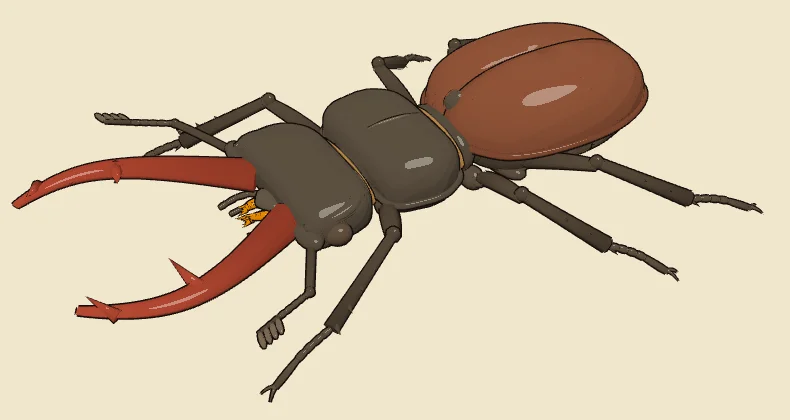
- Mandible mandibula
- Compound eye oculus compositus
- Antennal club clava
- Pronotum pronotum
- Elytron elytron, pl. elytra
- Tarsus tarsus
- and 44 more, from the ligula to the Malpighian tubules
Written like an exam note, because it is one
Mandible mandibula
The antlers are mandibles, not horns: they are jointed mouthparts. Females have short mandibles that bite much harder.
Antennal club clava
The classic trap: in Scarabaeidae (chafers, dung beetles) the lamellae can be closed together; in Lucanidae they cannot.
Quoted from the game's part cards.
A lesson in four moves
The order a pupil meets things in the game. Each step works on a classroom screen or a tablet.
Live it
Walk, climb and fly as the beetle in the oak wood.
Observe
Tap an insect, plant or fungus. Its page joins the notebook.
Open the specimen
Turn it, explode it, look inside: gut, nerves, tracheae.
Take the quiz
Name the parts on the plate, then check the cards.
Bring the plate to your class or museum
Tell us the age of your visitors and what you would like them to learn.